

Table of Contents
- Why Accurate Measurements Matter for Harness Fit
- What You'll Need Before You Start Measuring
- How to Measure a Dog for a Harness: Step-by-Step
- How to Read a Dog Harness Size Chart
- How to Fit a Dog Harness: Getting the Fit Right
- Signs a Dog Harness Is Too Small (or Too Large)
- Measuring Dogs With Unique Body Shapes
- Frequently Asked Questions
Last Updated: September 25, 2026
Why Accurate Measurements Matter for Harness Fit
A loose harness lets a determined dog back out in seconds; a tight one rubs the skin raw. Learning how to measure dog harness sizing prevents both problems.
What You'll Need Before You Start Measuring
Two tools make this job easy. Everything else is optional.
- A flexible measuring tape. A cloth tailor's tape works best. With a metal tape, use string, mark it, then lay it flat against a ruler.
- Treats. Small, smelly ones. You need your dog standing still for 30 seconds at a time.
- A helper. Nice to have, not required. One person holds the treat, the other measures.
- Your dog's current weight. Useful as a cross-check against the size chart.
How to Measure a Dog for a Harness: Step-by-Step
Three measurements cover almost every harness: chest girth, neck circumference, and back length. Chest girth matters most, if you only have time for one, do that one.
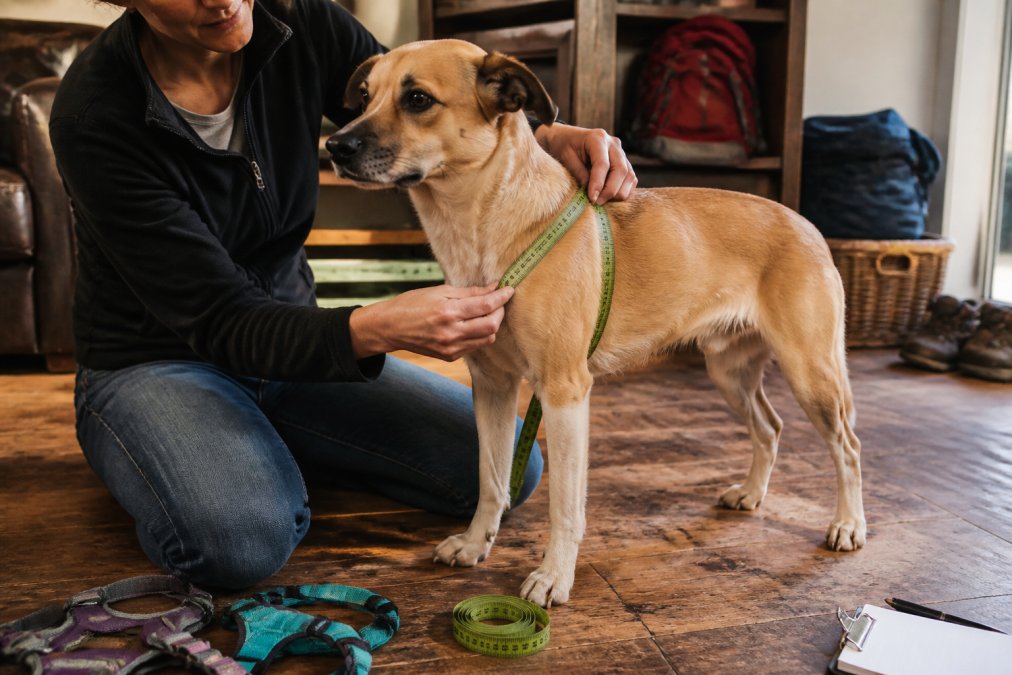
Step 1: Measure the Chest Girth
Chest girth is the distance around the widest part of the rib cage, just behind the front legs. This number decides harness size.
- Stand your dog on all fours.
- Find the point just behind the front legs, where the rib cage is deepest.
- Wrap the tape around the body, passing under the belly and over the back.
- Keep the tape snug against the fur but not tight.
- Read the number where the tape meets itself.
Step 2: Measure the Neck Circumference
Neck circumference is the distance around the middle of the neck, between the ears and shoulders. It matters for step-in and overhead harnesses.
Step 3: Measure the Back Length
Back length runs from the base of the neck to the base of the tail along the spine. It matters for harnesses with a long back panel.
How to Read a Dog Harness Size Chart
A dog harness size chart lists chest girth ranges per size, sometimes with neck and weight ranges. Chest girth decides in almost every case, but charts are not standardized, that is where most sizing mistakes happen.
| Measurement | What It Decides | Common Range Across Sizes |
|---|---|---|
| Chest girth | Harness size | Roughly 30-110 cm |
| Neck circumference | Step-in and overhead styles | Roughly 25-60 cm |
| Back length | Coverage and strap placement | Roughly 20-70 cm |
| Body weight | Cross-check only | Varies by breed |
Why the Same Number Lands in Different Sizes
A 60 cm chest girth might be Medium in one brand and Large in another. Two things cause this:
- Where the brand measures. Some measure at the tightest adjustment, others at the midpoint. A harness listed as fitting 55-70 cm may only reach 55 cm fully extended.
- How much adjustment is built in. A harness with 15 cm of strap adjustment covers a wider girth range than one with 5 cm, even if both are labeled the same size.
Reading the Chart Step by Step
- Find your chest girth number.
- Locate the size range it falls inside.
- Check the neck range for that size too.
- Confirm your number is not within 3 cm of either end of the range.
- Cross-check weight only as a sanity test.
Weight is a cross-check, not a decision-maker. A lean 30 kg dog and a stocky 30 kg dog will not wear the same size.
What to Do When Your Dog Is Between Sizes
This is the most common sizing problem, and the answer depends on harness style:
- Back-clip harnesses. Size up. The girth strap sits behind the rib cage, and adjustable straps take up the extra length without changing where the harness sits.
- Front-clip / no-pull harnesses. Size to the chest girth, not up. A too-large front-clip slides sideways when the dog pulls, defeating the steering effect and rubbing the shoulders.
- Step-in harnesses. Size to the neck and chest together. If the neck opening is too large, the dog can back out even when the chest fits.
Material Stretch Changes the Math
Webbing and padded straps relax with use, depending on the material:
- Nylon webbing. Stretches very little, but the weave can loosen at the buckle. Recheck the two-finger rule after the first month.
- Neoprene padding. Compresses rather than stretches. A padded harness can feel snug on day one and correct after a week.
- Leather. Stretches most in the first few weeks, then stabilizes. Buy leather slightly snug, not loose.
How to Fit a Dog Harness: Getting the Fit Right
A properly fitted harness sits on the shoulder blades, not the throat. The chest strap crosses the sternum and the girth strap sits behind the rib cage.
Once the harness is on, check these points:
- Two-finger rule. Two fingers should fit under every strap. Less is too tight; more is too loose.
- Shoulder clearance. The front straps should not cross the shoulder joint. That is where rubbing starts.
- Front-clip placement. A front-clip ring should sit at the sternum, centered on the chest.
- Back-clip placement. A back-clip ring should sit between the shoulder blades, not on the neck.
- Buckle security. Tug each buckle gently. It should not slide.
Signs a Dog Harness Is Too Small (or Too Large)
Signs a dog harness is too small show up fast: chafing under the front legs, red marks on the chest, and a dog that freezes mid-walk or refuses to move.
Watch for these too:
-
Fur worn thin or rubbed away at contact points
-
The dog pulling backward when you reach for the harness
-
A visible gap between the chest strap and the sternum
-
Limited range of motion in the front legs
-
The dog backs out of it, especially when startled
-
The harness rotates to one side during walks
-
Straps hang loose even when tightened fully
-
The chest strap slips down toward the belly
Measuring Dogs With Unique Body Shapes
Standard size charts assume a standard dog, but the shape of the rib cage matters more than the number on the tape. Here is how to measure dog harness fit and choose for body types that break standard sizing.
Deep-Chested Dogs (Sighthounds and Similar Builds)
Greyhounds, Whippets, Salukis, and other sighthounds have a rib cage that drops below the elbow line and a sharply tucked waist. A harness sized to the deepest chest is far too loose at the waist, and one sized to the waist will not close around the chest.
Barrel-Chested Dogs (Bulldog and Mastiff Types)
English Bulldogs, French Bulldogs, Boxers, and Mastiffs carry a wide, round rib cage, a short back, and often a comparatively narrow neck. The chest is wider than it is deep, and the shoulder sits close to the neck.
Dogs With a Wide Chest and Narrow Neck
Some bulldog and mastiff crosses, and many terrier mixes, have a chest girth two sizes larger than their neck measurement suggests. Match the chest girth first, then confirm the neck straps close down far enough. If they bottom out before snug, the harness is the wrong shape, not the wrong size.
Mobility-Impaired Dogs and Tripawds
For a dog with limited front-leg movement, a tripawd, or a senior with joint pain, the goal is a harness that goes on without threading a leg through a loop or lifting the dog.
Dogs With Thick or Double Coats
Huskies, Malamutes, Newfoundlands, and other double-coated breeds carry undercoat that compresses under a strap. Measure the coat, since that is what the harness sits on, but recheck the fit after a groom or seasonal blow, a harness that fits in January may be loose in July.
Material Stretch and Body Shape Together
Material choice interacts with body shape. A deep-chested dog in nylon gets very little give, so the measurement must be accurate from the start. A barrel-chested dog in padded or neoprene gear gets some compression at the chest plate, which can help a between-size fit. Leather stretches most in the first weeks, so measure a deep-chested dog snug, not loose.
Frequently Asked Questions
How do I know what size harness to get for my dog?
Measure your dog's chest girth at the widest point behind the front legs, then measure the neck circumference at the base of the neck. Compare those numbers to the manufacturer's size chart. If your dog falls between two sizes, size up for adjustability. Always measure at home before ordering to avoid returns, and recheck every few months since weight changes can shift sizing.
How tight should a dog harness be?
A properly fitted harness should be snug but not restrictive. You should be able to slide two fingers flat between the strap and your dog's body at every adjustment point. If you can fit more than two fingers, the harness is too loose and your dog may slip out. If you cannot fit two fingers, it is too tight and will cause chafing or restrict breathing and movement.
Should I measure my dog while they are standing or sitting?
Always measure your dog while standing. A standing position gives you the most accurate chest girth and back length because the body is fully extended. If your dog sits, the chest compresses and the measurement will read smaller than it actually is. Have a helper hold a treat in front of your dog to keep them standing still during measurement.
How do I measure a dog with a deep chest for a harness?
Deep-chested breeds need extra attention at the chest girth measurement. Measure at the deepest part of the rib cage, usually right behind the front legs. Note both the chest girth and the neck circumference separately, because deep-chested dogs often need a harness with independent chest and neck adjustment. Look for a dog harness size chart that lists chest girth as the primary sizing dimension rather than weight.